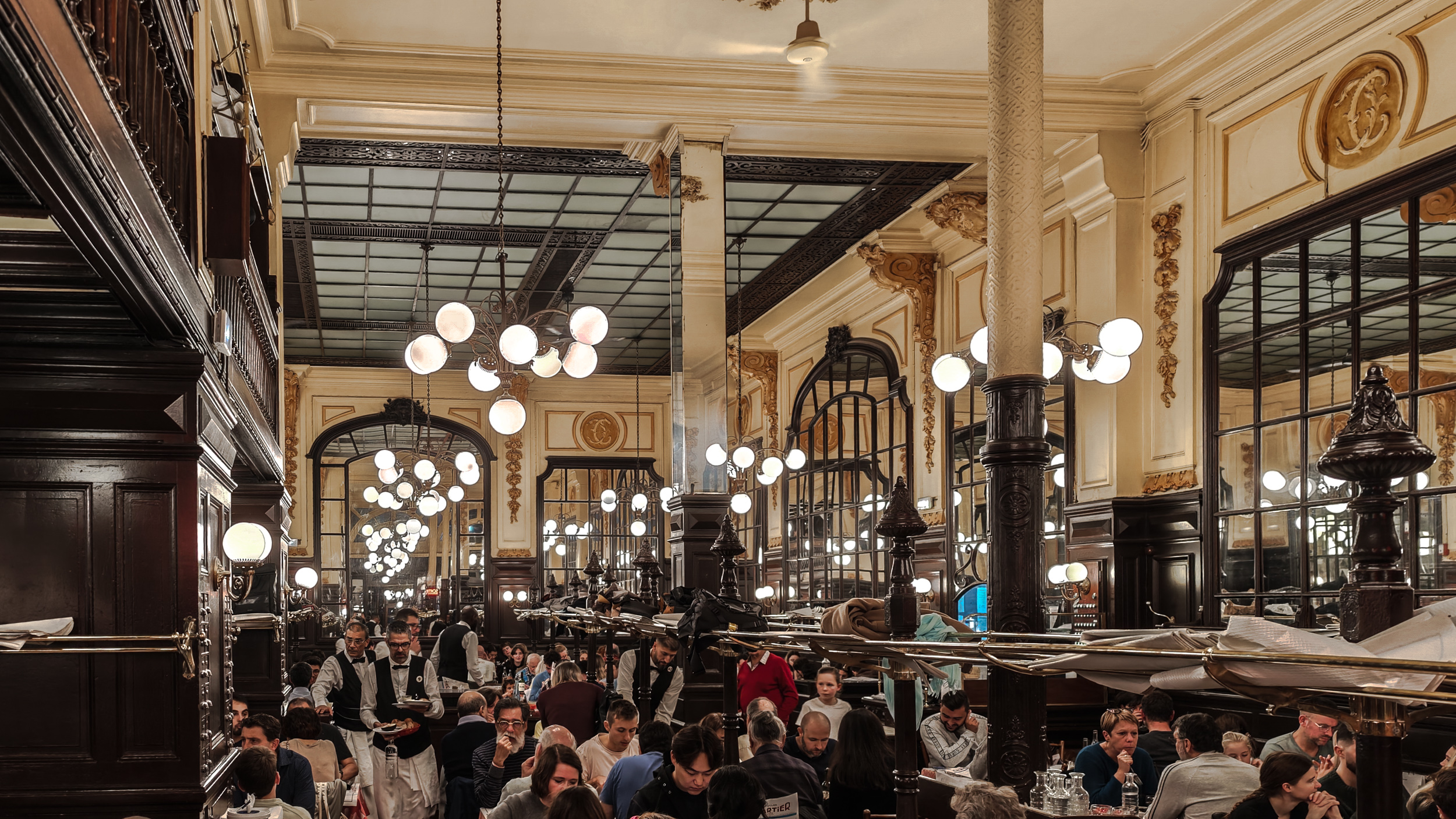
Hell beleuchtet und fast immer überfüllt – Der Jugendstilsaal des “Chartier” von 1898
Eine Bildergalerie zu diesem Beitrag finden Sie HIER
English version following this report
Pariser Bouillons – Küche mit Stil für alle
Wer Paris verstehen will, so heißt es, der muss essen gehen. Und wer Paris fühlen und mit einer virtuellen Zeitmaschine in das Paris des 19. Jahrhunderts reisen möchte, der setze sich an einen der marmorgefliesten Tische der mehr als ein Dutzend Bouillon-Restaurants, die inzwischen in der Hauptstadt täglich geöffnet haben. Hier wird nicht inszeniert, hier wird serviert. Laut, meist schnell und nicht immer herzlich – und das zum Teil seit mehr als hundert Jahren.
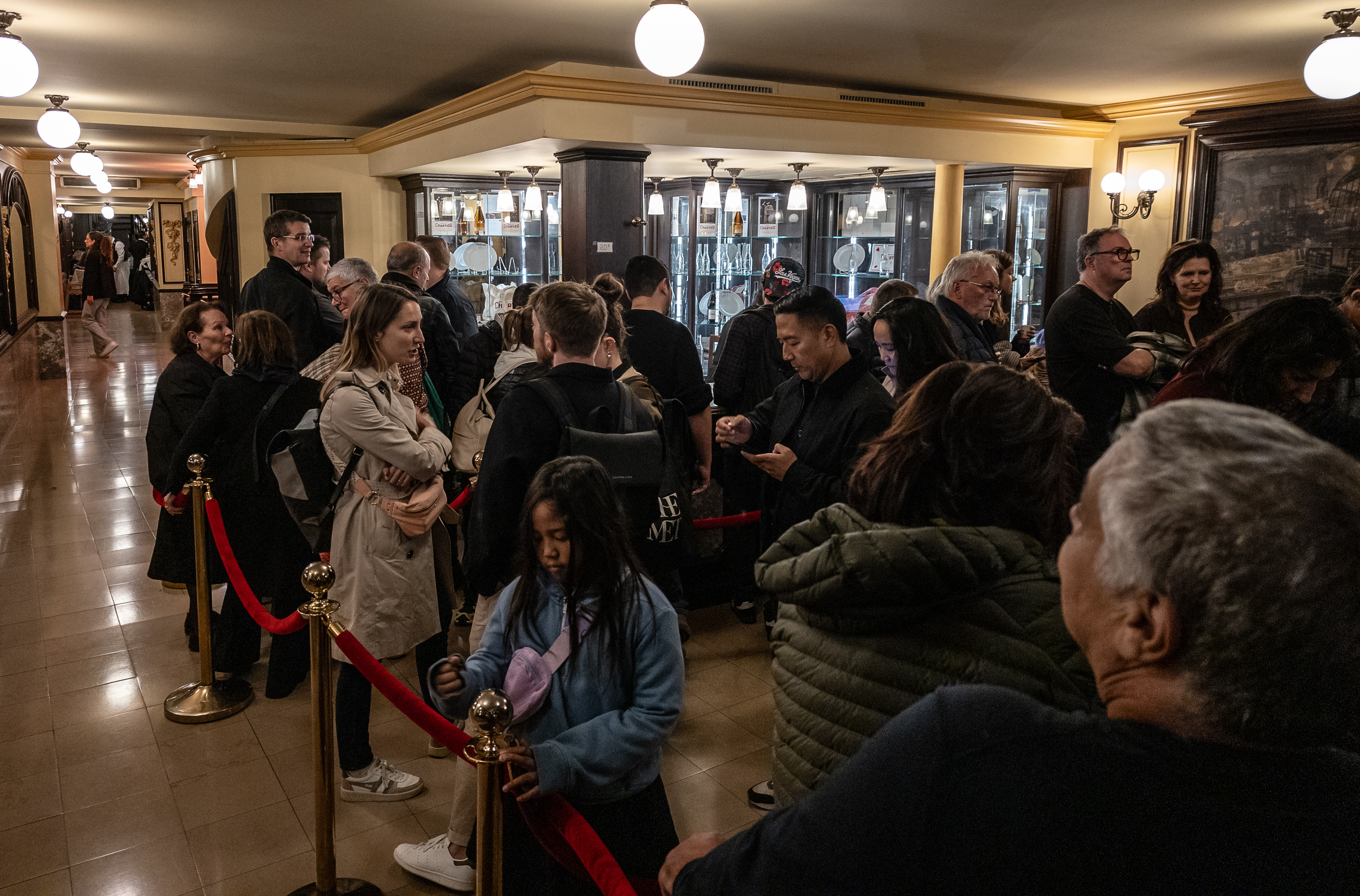
Meine Frau und ich hatten den Besuch eines dieser Traditionslokale nach einem appetit-anregenden Bericht in einer großen schweizer Tageszeitung für unsere fünftägige Reise an die Seine fest eingeplant; zumal mit dem “Chartier” eines der ältesten und berühmtesten Bouillons nur wenige hundert Meter von unserem Hotel entfernt lag. Doch unser erster Versuch scheiterte. Zu lange war die Schlange vor dem bis zum letzten Platz gefüllten Jugendstilsaal.
Kantinen für die Arbeiterklasse im 19. Jahrhundert
Bouillons entstanden Mitte des 19. Jahrhunderts als Kantinen für Arbeiter. Heute sind sie lebendige Zeitkapseln. Kellner in schwarzen Westen balancieren große Tabletts durch dicht gedrängte Reihen. Am Kücheneingang mischen sich laute Stimmen mit dem Klirren von Besteck, der Duft von Rinderbrühe, Zwiebeln und frisch gebackenem Brot liegt in der Luft. Auf den Tafeln am Eingang stehen Klassiker: Oeufs Mayo, Boeuf Bourguignon, Saucisse-Purée (Wurst mit Kartoffel-Purée, oder “Toad in the hole”), Ile Flottante (schwimmende Inseln). Gerichte ohne Schnickschnack – dafür mit Geschichte: Und in unserem Falle auch ausgesprochen wohlschmeckend. Solche Speisen sind permanent im Angebot. Die Weine sind allemal preiswert (gemessen an deutschen Lokalen sogar billig).
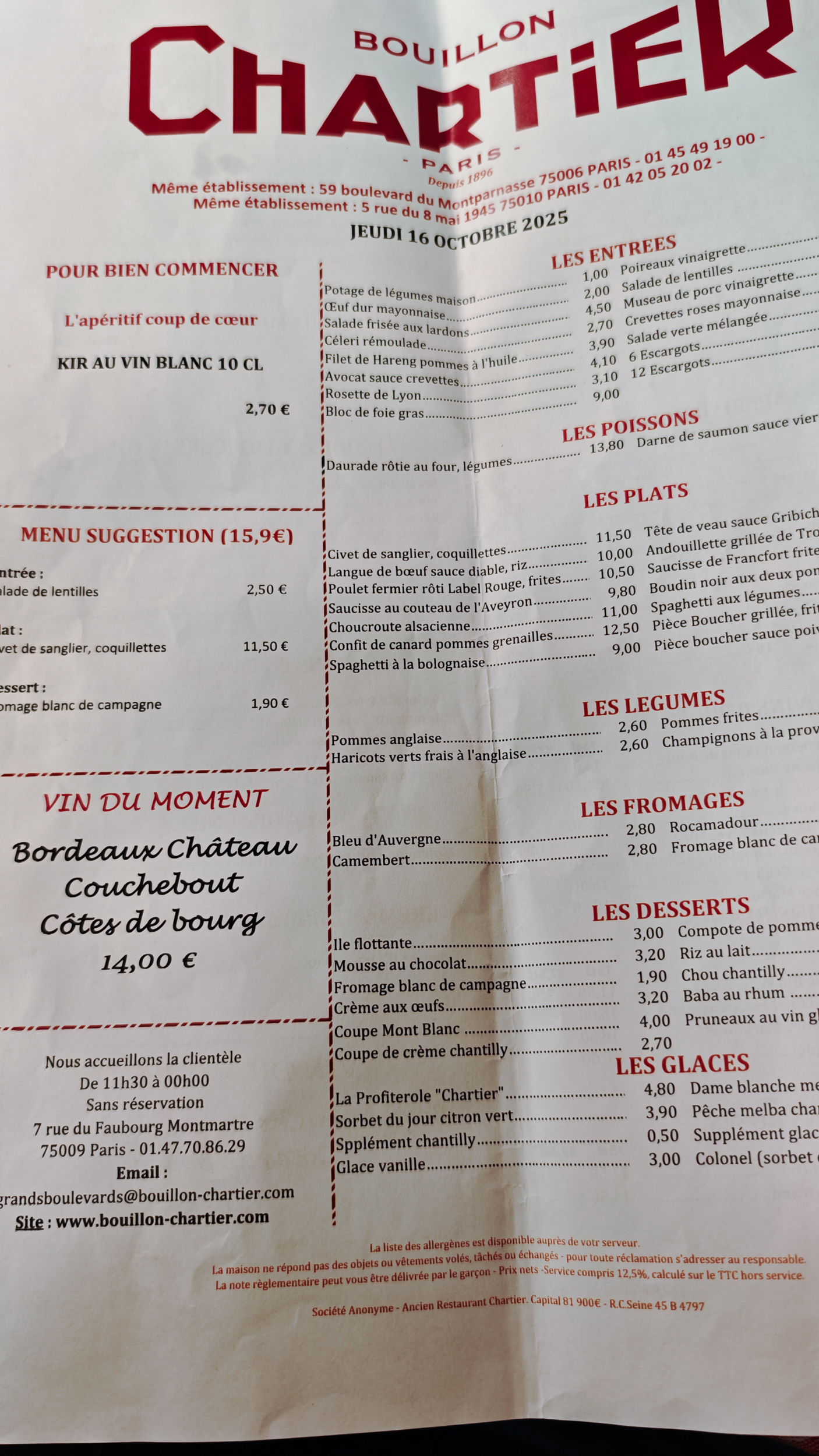
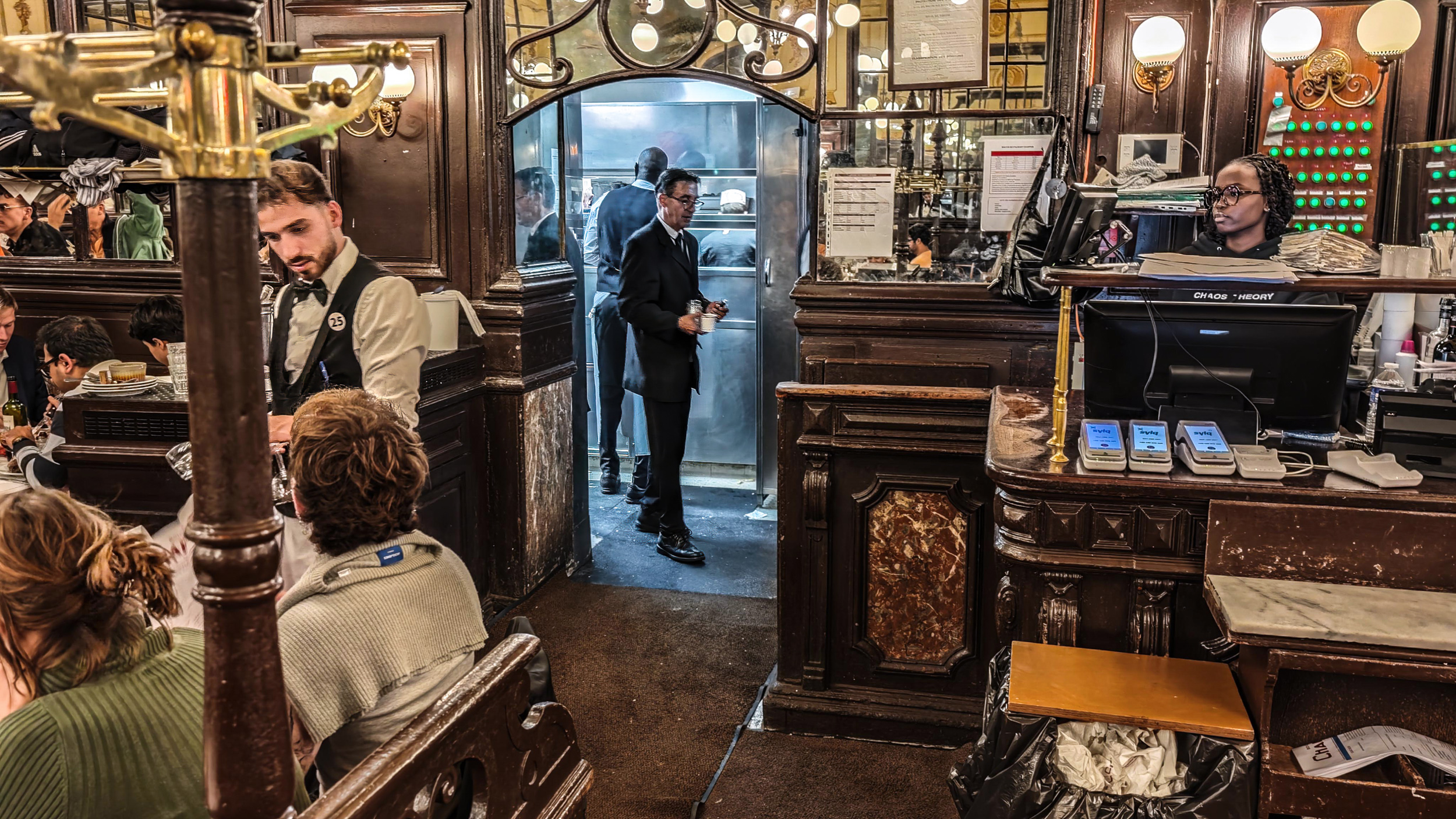
Das tägliche Menue findet man auf einem einfachen Blatt Papier. Die Kellner notieren die Bestellung der Einfachheit halber auf den weißen oder karierten Papier-Tischdecken. So wird nichts vergessen. Die im Kopf auf-addierte Rechnung wird dann ebenfalls auf diesem “Tischtuch” notiert und dann schlicht und einfach weggeworfen. Wie hier bei 350 Gästen zur Haupt-Essenszeit die Buchhaltung funktioniert, wissen vermutlich nicht einmal die Pariser Steuerbeamten. Nicht ohne Grund steht auf dem Tisch der Kassenverwalterin neben der Küche ein Schild mit der Aufschrift: “Chaos-Theory” .
Die Wegwerf-Speisekarte des “Chartier”
Fotografisch sind die klassischen Bouillons ein Geschenk. Spiegel vervielfachen den Raum, Jugendstil-Schriftzüge erzählen von einer anderen Zeit, und das warme, helle Licht lässt Gesichter und Teller gleichermaßen lebendig wirken. Zwischen Touristen und Stammgästen, zwischen Alltagsroutine und Nostalgie entsteht genau das, was Paris vermutlich ausmacht: Ein Nebeneinander von gestern und heute. “Bouillon” ist ein Versprechen, heißt es in einem Bericht. Hier gibt es gutes Essen zu fairen Preisen, wie man sie in einem touristischen Zentrum wie Paris nicht erwartet. Offen sind diese Restaurants für alle. Hier gibt es keinen Zwang zu “feiner Kleidung”, keine Reservierungen; und so dürften hier drei Viertel der Gäste unter 40 Jahren alt sein. In vieler Hinsicht sind diese Lokale vergleichbar mit den international vermutlich bekannteren und berühmteren Wiener Kaffeehäusern, die – trotz aller erzwungenen Veränderungen – in den vergangenen 50 Jahren die Tradition bewahrt haben.
Bis zu 2400 Essen am Tag
Wie die Ober den Stress mit dem nicht enden wollenden Strom von Gästen körperlich verkraften, konnten wir natürlich nicht in Erfahrung bringen. Auch nicht, wieviel sie mit diesem Knochenjob verdienen. Ein solcher Massenbetrieb muss hervorragend organisiert sein: Das “Chartier” ist an 7 Tagen der Woche von 11:00 Uhr bis Mitternacht durchgehend geöffnet (die Bouillons Pigalle und Republique je zwölf Stunden bis Mitternacht). Die 350 Sitzplätze sind in der Mittagszeit stets mehrere Stunden belegt. An manchen Tagen werden hier bis zu 2 400 Essen ausgegeben.
Natürlich darf man bei den knapp kalkulierten Preisen für Speisen und Getränke keine Sterneküche auf feinstem Porzellan erwarten. Doch das angebotene Menue schmeckte trotzdem! Meine Frau meinte jedenfalls, sie habe in ihrem Leben keine bessere konfierte Entenkeule gegessen! Am Ende zahlten wir für ein Drei-Gänge Menü sowie eine Vorspeise und einen Hauptgang, eine halbe Flasche Weißwein und ein Mineralwasser 45 €. Uns störte es kaum, dass wir 45 Minuten auf einen Kellner warten mussten, weil sich die Herrn Ober nicht einigen wollten, wer uns denn bedienen sollte. Und niemand störte sich daran, dass ich nach dem Essen durch die Tischreihen lief, um für diesen Bericht zu fotografieren.
Bouillon-Restaurants in Paris:
Um 1900 gab es in Paris über 250 Bouillons. Heute ist deren Zahl auf zwölf gesunken. Zu den bekanntesten zählen das hier beschriebene “Chartier” mit mindestens drei weiteren Filialen (Grands Boulevards, Montparnasse, Gare de l’Est). Zu den besonders schönen Bouillons zählen auch das “Bouillon Julien” im 10. Arrondissement, oder das “Bouillon Racine”. Doch auch außerhalb der Hauptstadt findet man Restaurants, die dem Konzept der Pariser Bouillons zumindest nachempfunden wurden. Neben Paris gibt es Bouillons oder Bouillon-inspiriertes Essen unter anderem in Lyon, Lille, Metz, Grenoble, Orléans, Dijon, Tours oder Strasbourg. Der Trend ist Teil einer größeren Bewegung: Erschwingliche, traditionelle Küche mit schneller Bedienung und attraktivem, geselligem Ambiente – auch als Reaktion auf ständig steigende Preise bei gleichzeitig steigender Nachfrage nach bezahlbaren Restaurants.
Eine Bouillon ist eine Brühe, ist eine Brühe, ist …
eine klare, kräftige Suppe, die durch langes Köcheln von Fleisch, Knochen (meist Rind) und Suppengrün in Wasser entsteht. Sie dient als eigenständige Suppe oder Basis für Saucen. Zutaten sind Wasser, Rindfleisch/Knochen, Gemüse (Möhren, Sellerie, Lauch) sowie Gewürze (Lorbeer, Pfeffer).
- Basis: Wasser, Fleisch (Rind, Kalb, Geflügel) und Knochen.
- Gemüse: Klassisches Suppengrün (Karotten, Sellerie, Lauch) und Zwiebeln.
- Gewürze: Salz, Pfeffer, Lorbeer, oft Petersilie.
- Herstellung: Die Zutaten köcheln mehrere Stunden langsam (ziehen), um den intensiven Geschmack zu extrahieren.
_____________________________
English version
Brightly lit and almost always packed – the Art Nouveau dining room of the ‘Chartier’, dating from 1898
You can find a photo gallery for this article HERE
Parisian bouillons – stylish cuisine for everyone
They say that if you want to understand Paris, you have to go out for a meal. And anyone wishing to experience Paris and travel back to 19th-century Paris in a virtual time machine should take a seat at one of the marble-topped tables in the more than a dozen bouillon restaurants that are now open daily in the capital. Here, there is no show; here, the food is simply served. Noisy, usually fast and not always warm – and in some cases, this has been the case for over a hundred years.
My wife and I had firmly planned a visit to one of these traditional establishments for our five-day trip to the Seine following an appetising report in a major Swiss daily newspaper; especially as ‘Chartier’, one of the oldest and most famous bouillon restaurants, was just a few hundred metres from our hotel. But our first attempt failed. The queue outside the Art Nouveau dining room, packed to the last seat, was simply too long.
There are no reservations: here you queue until a table becomes free
Canteens for the working class in the 19th century
Bouillons originated in the mid-19th century as canteens for workers. Today they are living time capsules. Waiters in black waistcoats balance large trays through tightly packed rows. At the kitchen entrance, loud voices mingle with the clatter of cutlery; the scent of beef broth, onions and freshly baked bread hangs in the air. The boards at the entrance list classics: Oeufs Mayo, Boeuf Bourguignon, Saucisse-Purée, Ile Flottante (floating islands). Dishes without frills – but with history: and in our case, also exceptionally tasty. They are always on the menu. The wines are always reasonably priced (even cheap by German standards).
The daily menu is printed on a simple sheet of paper. For the sake of simplicity, the waiters jot down orders on the white or chequered paper tablecloths. That way, nothing gets forgotten. The bill, calculated in their heads, is then also noted on this ‘tablecloth’ and later simply thrown away. How the bookkeeping works here with 350 guests at peak mealtimes is something not even the Parisian tax officials probably know. It is not without reason that there is a sign on the cashier’s desk next to the kitchen bearing the inscription: “Chaos Theory”
Photographically, the classic bouillons are a gift. Mirrors multiply the space, Art Nouveau lettering speaks of a bygone era, and the warm, bright light brings faces and plates alike to life. Amidst tourists and regulars, amidst daily routine and nostalgia, there emerges precisely what Paris is all about: a coexistence of yesterday and today. “Bouillon” is a promise, according to one report. Here, there is good food at fair prices, the sort one wouldn’t expect in a tourist hub. These restaurants are open to everyone. There is no requirement for “smart dress”, no reservations; and so three-quarters of the guests here are likely to be under 40 years old. In many respects, these establishments are comparable to the Viennese coffee houses, which are probably better known and more famous internationally and which – despite all the changes – have preserved the tradition over the past 50 years.
Up to 2,400 meals a day
Of course, we were unable to find out how the waiters physically cope with the stress of the never-ending stream of guests. Nor how much they earn from this gruelling job. A business of this scale must be superbly organised, as the ‘Chartier’ is open non-stop seven days a week from 11:00 am until midnight (the Bouillons Pigalle and Republique each open for twelve hours until midnight). The 350 seats are always occupied for several hours at lunch- and dinnertime. On some days, up to 2,400 meals are served here.
Of course, given the tightly calculated prices for food and drink, you can’t expect Michelin-starred cuisine served on the finest china. But the menu on offer tasted great nonetheless! My wife, at any rate, said she’d never eaten a better confit duck leg in her life! In the end, we paid €45 for a three-course meal – a starter and a main course – plus half a bottle of white wine and a bottle of mineral water. And it hardly mattered that we had to wait 45 minutes for a waiter because the head waiters couldn’t agree on who should serve us. Nor did anyone mind that I walked through the rows of tables after the meal to take photos for this report.
Bouillon restaurants in Paris:
At the turn of the 20th century, there were over 250 bouillons in Paris. Today, that number has fallen to twelve. Among the best known is the ‘Chartier’ described here, which has at least three other branches (Grands Boulevards, Montparnasse, Gare de l’Est). Among the particularly charming bouillons are also “Bouillon Julien” in the 10th arrondissement, or “Bouillon Racine”.
But even outside the capital, one can find restaurants that have at least been modelled on the bouillon concept. Besides Paris, there are now bouillons or bouillon-inspired dining in several cities, including Lyon, Lille, Metz, Grenoble, Orléans, Dijon, Tours and Strasbourg. The trend is part of a wider movement: affordable traditional cuisine with fast service and an attractive, convivial atmosphere – partly in response to ever-rising prices and the demand for affordable restaurants.
A bouillon is a broth, is a broth, is …
a clear, rich soup produced by simmering meat, bones (usually beef) and soup vegetables in water for a long time. It serves as a soup in its own right or as a base for sauces. Ingredients include water, beef/bones, vegetables (carrots, celery, leeks) and spices (bay leaves, pepper).
Main components and characteristics:
- Base: Water, meat (beef, veal, poultry) and bones.
- Vegetables: Classic soup vegetables (carrots, celery, leeks) and onions.
- Spices: Salt, pepper, bay leaves, often parsley.
- Preparation: The ingredients are simmered slowly for several hours to extract the intense flavour.